
Learn With Examples · Algebra Basics
Both are “just numbers” in an algebra expression, which is exactly why students mix them up. But they do completely different jobs. One number is glued to a variable and scales it; the other stands alone and never moves. Learn to tell them apart and half of algebra suddenly gets easier.
Take a taxi in almost any city and you’ll pay something like this: a fixed amount the moment you sit down, then a certain amount for every kilometre. Say ₹50 to start and ₹15 per km. Your fare is 15k + 50, where k is kilometres driven.
Look at those two numbers. The 15 is attached to the k. It grows your fare with every kilometre: a longer trip means more fifteens. The 50 isn’t attached to anything. Drive 1 km or 40 km, it’s the same 50. That’s the entire difference between a coefficient and a constant, and you’ve been paying for it in every taxi you’ve ever taken.
I’ve tutored algebra long enough to know this distinction trips up far more people than its simplicity suggests. It isn’t hard. It just gets taught as a vocabulary definition to memorise, when really it’s a question of behaviour: which number changes the result when the variable changes, and which one doesn’t care. Once you see it that way, you won’t need to memorise anything.
Coefficient = multiplier. Constant = fixed amount.
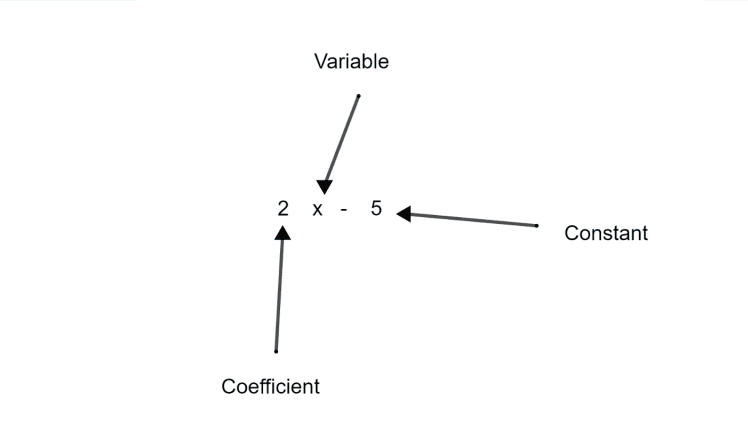
A coefficient is the number multiplied by a variable. In 7x, the coefficient is 7. It tells you how much of the variable you have, so its effect grows as the variable grows.
A constant is a number standing on its own, with no variable attached. In 7x + 4, the constant is 4. Its value never changes, whatever x turns out to be.
Anatomy of an expression
Before comparing them further, it helps to see every part of an algebraic expression labelled at once. Here’s one with all four pieces you’ll meet:
Two details there catch almost everyone. First, the coefficient of the middle term is −3, not 3. The minus sign belongs to the coefficient. Second, the 2 is not a coefficient, even though it’s a number next to x. It’s an exponent: it says “x times x”, not “two lots of x”. Position matters. A number in front multiplies; a small raised number is a power.
The chunks separated by + and − are called terms. This expression has three: 5x², −3x and 7. A term with a variable in it is a variable term. A term that’s only a number is the constant term. Every term has at most one constant role and one coefficient role, and spotting which is which is what this whole article trains.
Side by side
Coefficient
- Always attached to a variable (
4y,−2a,½x) - Acts as a multiplier, a rate or a “per” amount
- Its effect grows as the variable grows
- On a graph, it sets the steepness
- Real life: price per item, speed, hourly wage, interest rate
Constant
- Stands alone, with no variable (
+ 9,− 12) - Acts as a fixed amount, a starting value or a base fee
- Its effect never changes, whatever the variable does
- On a graph, it sets the starting height
- Real life: booking fee, monthly rent, joining fee, a head start
Ask one question of any number: “if x doubles, does this number’s contribution double?” If yes, it’s a coefficient. If no, it’s a constant.
What each one does to a graph
This is where the difference stops being vocabulary and becomes something you can actually see. Take the equation y = 2x + 3 and draw it. Then change each number separately and watch what happens.
y = 2x + 3. Raise the coefficient from 2 to 3 and the line tilts (dashed blue): same starting point, steeper climb. Raise the constant from 3 to 7 and the line slides up (pink): same steepness, higher start.That picture carries the whole distinction. In a straight-line equation y = mx + c, the coefficient m is the slope, how fast y changes when x changes. The constant c is the y-intercept, where the line crosses the vertical axis, or equivalently the value of y when x is zero.
Which is why, in the real world, the coefficient is almost always a rate (per km, per hour, per unit, per month) and the constant is almost always a starting amount (a base fee, an opening balance, a head start). Whenever you read a pricing plan, you’re reading a coefficient and a constant.
Six real-world formulas
Every one of these is a real formula you’ve met or will meet. Tap through them and, before reading the answer, try to name which number is the coefficient and which is the constant.
Spot the coefficient and the constant
tap an exampleA taxi ride
A 4 km ride costs 15 × 4 + 50 = ₹110. A 20 km ride costs 15 × 20 + 50 = ₹350. The constant stayed at 50 both times; the coefficient did all the growing. And notice: on short trips the constant dominates, which is why tiny taxi rides feel expensive per kilometre.
A mobile data plan
Use 5 extra GB and you pay 12 × 5 + 199 = ₹259. Use none and you still pay ₹199. This is exactly why comparing phone plans is a coefficient-versus-constant trade-off: a plan with a low constant and high coefficient suits light users, and the reverse suits heavy users.
Base salary plus commission
Sell ₹2,00,000 worth and your pay is 0.05 × 2,00,000 + 25,000 = ₹35,000. The coefficient can be a decimal. It’s still a coefficient, because it multiplies the variable. A job offer that trades a lower constant for a higher coefficient is betting on how much you’ll sell.
A gym membership
A year costs 1,200 × 12 + 2,000 = ₹16,400. The joining fee, the constant, matters less the longer you stay, because it’s spread across more months. That’s the whole logic behind “no joining fee” offers: they’re betting you’ll stay long enough for the coefficient to earn it back.
Celsius to Fahrenheit
30°C becomes 1.8 × 30 + 32 = 86°F. Here the two numbers have a lovely physical meaning. The coefficient converts the size of a degree; the constant fixes the fact that the two scales start counting from different zero points.
A child’s savings jar
After 10 weeks: 100 × 10 + 500 = ₹1,500. Here the constant is a head start rather than a fee. The pattern is the same: the constant is where you begin, the coefficient is how fast you move from there.
Six different worlds, one identical shape: rate × amount + starting value. Once you see it, you’ll find it in electricity bills, parking charges, delivery fees and loan statements.
The tricky cases
Clear examples are easy. These are the ones that show up on tests precisely because they look different from the textbook pattern.
The invisible coefficient: what’s the coefficient of x?
In x + 5, the coefficient of x is 1. Nobody writes 1x because multiplying by one changes nothing, but the 1 is still there. Likewise, in −x the coefficient is −1. This matters the moment you start adding or rearranging terms: x + 4x = 5x only works if you remember that x means 1x.
Negative numbers: is it 3 or −3?
The sign travels with the number. In 8 − 3y, the coefficient of y is −3, not 3. In 2x − 9, the constant is −9. A useful trick: rewrite every subtraction as adding a negative. 2x − 9 becomes 2x + (−9), and the constant is now obvious.
Fractions and division: what’s the coefficient in x/4?
Dividing by 4 is the same as multiplying by ¼, so the coefficient is ¼ (or 0.25). Similarly 3x/5 has coefficient 3/5. Division hides the multiplier, but it’s still there.
No constant at all: what’s the constant in 6x?
There isn’t one written, so the constant is 0. On a graph, y = 6x passes straight through the origin, the point (0, 0), because with no fixed amount, y starts at zero. A formula like cost = 40 × hours with no call-out fee behaves exactly this way.
π, e and other famous numbers: are they constants?
In A = πr², the π is multiplying r², so within this formula it’s the coefficient. It’s a mathematical constant, a number whose value never changes, but its role in the expression is to multiply a variable. “Constant” in the sense of “never-changing number” and “constant term” in the sense of “standing alone” are two different ideas that happen to share a word.
Two variables in one term: what’s the coefficient in 4xy?
The numerical coefficient is 4. Some textbooks go further and say “the coefficient of x in 4xy is 4y”, treating everything except x as its coefficient. Both are used; most school-level questions mean the plain number, 4. If a question asks for “the coefficient of x” in a multi-variable term, read it carefully.
What’s the “leading coefficient”?
It’s the coefficient of the term with the highest power. In 5x³ − 2x + 9, the leading coefficient is 5. It controls how the graph behaves far out to the left and right, which is why you’ll meet the term constantly once you study polynomials.
The exponent trap, one more time. In x³, the 3 is not a coefficient. 3x means x + x + x; x³ means x × x × x. If x is 4, the first is 12 and the second is 64. Mixing up a coefficient and an exponent is the single most common error on this topic, so check where the number sits every time.
Everything on one card
| Expression | Coefficient(s) | Constant | Worth noticing |
|---|---|---|---|
| 7x + 4 | 7 | 4 | The textbook case |
| x − 10 | 1 | −10 | Invisible 1, negative constant |
| −y + 3 | −1 | 3 | The minus belongs to the coefficient |
| 9a | 9 | 0 | No constant written means zero |
| x/2 + 6 | ½ | 6 | Division is a fractional coefficient |
| 4x² − x + 1 | 4 and −1 | 1 | The 2 is an exponent, not a coefficient |
| πr² | π | 0 | A mathematical constant acting as a coefficient |
| 15 | none | 15 | A lone number is all constant |
Why the difference actually matters
It’s fair to ask why anyone should care about the names. Here’s why: almost every algebra skill that comes after depends on treating these two numbers differently.
You add coefficients, not constants to variables
3x + 5x = 8x, because you add the coefficients. But 3x + 5 can’t be simplified at all: a variable term and a constant term aren’t “like” terms.
Constants move first, coefficients go last
To solve 4x + 7 = 31, subtract the constant (7) from both sides, then divide by the coefficient (4). Get the order backwards and the arithmetic gets messy fast.
Slope and intercept
The coefficient tells you the steepness, the constant tells you the starting height. Read those two numbers and you can sketch the line without plotting a single point.
Fixed cost vs rate
Choosing a phone plan, a job offer or a gym is really choosing between a lower constant and a lower coefficient. Knowing which is which tells you who each deal is designed for.
Here’s the solving order in action, because it’s where the distinction earns its keep:
4x = 31 − 7 = 24 ← undo the constant first
x = 24 ÷ 4 = 6 ← then undo the coefficient Constants are removed by adding or subtracting. Coefficients are removed by dividing. That’s why you always deal with the constant first.
A memory hook that works. The coefficient co-operates with the variable: they’re stuck together and change together. The constant is constantly the same: nothing you do to x can budge it. Students who learn the two words through what they do, not what they’re called, rarely confuse them again.
Four common mistakes
Dropping the sign
Saying the coefficient of −6x is 6. It’s −6. The sign changes the meaning completely: a rate of −6 means the value falls.
Calling an exponent a coefficient
In x², the 2 is a power. The coefficient is the invisible 1 in front.
Forgetting the hidden 1
x has a coefficient of 1. Forget it and x + 3x becomes 3x instead of 4x.
Merging unlike terms
Writing 2x + 5 = 7x. A constant can never be combined with a variable term; they measure different things.
Check yourself
Five questions. Open each to check. The correct option is marked.
1. In 9y − 4, what is the constant?
- 9
- 4
- −4
- y
The constant is the term with no variable, and the minus sign belongs to it: −4.
2. What is the coefficient of x in x² + 3?
- 2
- 1
- 3
- 0
The 2 is an exponent. The coefficient is the invisible 1 multiplying x².
3. A plumber charges ₹300 per call plus ₹400 per hour. In the cost formula, what is 400?
- The constant
- The coefficient
- The variable
- The exponent
Cost = 400h + 300. The 400 multiplies hours, so it’s the coefficient. The 300 call-out fee is the constant.
4. On the graph of y = 5x + 2, what does changing the 2 to 8 do?
- Makes the line steeper
- Shifts the line up without changing its steepness
- Makes the line flatter
- Nothing
The constant is the y-intercept. Changing it slides the whole line up or down. The steepness belongs to the coefficient.
5. Simplify 6x + 2 + 3x.
- 11x
- 9x + 2
- 9x + 2x
- 11
Add the coefficients of the like terms (6 + 3 = 9). The constant 2 has no x, so it stays separate.
Frequently asked questions
What is the difference between a coefficient and a constant?
A coefficient is a number multiplied by a variable, like the 7 in 7x, and its effect changes as the variable changes. A constant is a number on its own with no variable, like the 4 in 7x + 4, and its value stays fixed regardless of the variable.
Can a coefficient be negative, a fraction or a decimal?
Yes. In −3x the coefficient is −3; in x/2 it’s ½; in 0.05s it’s 0.05. Any number multiplying a variable is its coefficient, whatever kind of number it is.
What is the coefficient of x if no number is written?
It’s 1. The expression x means 1 × x, and −x means −1 × x. The 1 simply isn’t written.
Is a constant always a positive number?
No. In 5x − 8, the constant is −8. Constants can be positive, negative, zero, fractions or decimals. What makes them constants is that they have no variable attached.
How do coefficients and constants appear on a graph?
In a straight-line equation y = mx + c, the coefficient m is the slope, which controls how steep the line is, and the constant c is the y-intercept, where the line crosses the vertical axis. Change the coefficient and the line tilts; change the constant and it slides up or down.
Is the number 2 in x² a coefficient?
No. That 2 is an exponent, meaning x is multiplied by itself. A coefficient sits in front of the variable and multiplies it; an exponent sits raised above it and indicates a power.
The takeaway
A coefficient multiplies a variable, so its effect grows and shrinks as the variable does. A constant stands alone, so its effect never changes at all. On a graph, the coefficient tilts the line and the constant slides it. In real life, the coefficient is the rate and the constant is the fixed starting amount.
The quickest test works on any expression you’ll ever meet: imagine doubling the variable, and ask which numbers’ contributions double with it. Those are coefficients. Whatever stays put is the constant. Watch out for the invisible 1, keep the minus signs attached, and never mistake a raised exponent for a coefficient.
Try it on a bill that’s lying around: your electricity statement, a delivery app’s fee breakdown, or your phone plan. Somewhere on it is a fixed charge and a per-unit rate. Write it as rate × units + fixed charge, and you’ll have translated a real piece of paper into algebra, with a coefficient and a constant exactly where you’d expect them.
coefficient vs constantalgebra basicsalgebraic expressionsslope and interceptlike termsmath vocabulary

